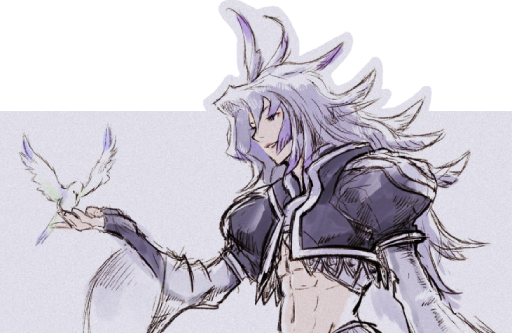
The immaterial angel of death
Upon reaching Terra, Zidane learns from its overseer, Garland, that Kuja is an "angel of death" sent to wreak havoc on Gaia in order to prepare its assimilation by the dying, parasitic planet. He's revealed to be a Genome—a tailed human who serves as a vessel for the souls of slumbering Terrans. As an angel of death who was given the mission to expedite the assimilation of Gaia by Terra, Kuja enjoys the privilege of having a soul to act with intention where most of his kin remain empty vessels. His body doesn't age, and he was made as he looks now. His strong sense of self from the outset, however, resulted in rebellious ambitions that spurred Garland on to create a second angel of death eight years later.
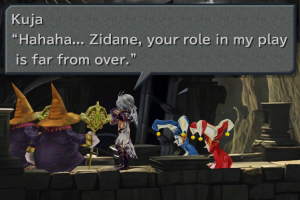
The creation of Zidane birthed two emotions in Kuja: envy and fear. Instead of eliminating the threat, he abandoned the four-year-old Zidane on Gaia out of spiteful poeticism to prove himself superior in time. For this act of insubordination, he was banned by Garland from entering Terra and thereby exiled to operate from within Gaia.
A beautifully ugly body
When the party first enters Bran Bal in Terra, they're greeted to the shocking sight of countless Genomes who all share Zidane's likeness between their heads of gold and tails. Even without taking the possession of a soul into account, it quickly becomes apparent that Kuja is something of an outlier among his own kind, effectively othering him on two planets. FINAL FANTASY Ultimania Archive Volume 2 further clarifies that he maintains appearances, though perhaps not in the way one might expect; rather than being blond like the rest of his kin, the original color of Kuja's hair is red like the moon of the very planet he's meant to serve.
For Kuja, who wishes to maintain his individuality more than anything else, any likeness to the subservient Genomes is one too many.
Zidane: Kuja!? He's a Genome!? Impossible! He doesn't even have a tail . . .
Garland: He is only hiding it. He denies his own identity. He rejects the meaning of his own existence and tries to assert his own individuality. Don't you see the resemblance?
Zidane: Shut up! I'm not like him at all!
Garland: He said the same thing when speaking about the other Genomes: 'I'm not like these guys.'
The Ultimania Archive states that Kuja's hatred and ridicule of the black mages, who are conceptually similar to Genomes, may stem from his self-loathing. As much as he raises his superiority over the purportedly inferior races of Gaia, the truth is that Kuja suffers from body dysmorphia. He denies his tail, because it's a reminder of how much he utterly hates what he is. Beneath his narcissism is a bog of insecurities and anxiety as he struggles to love himself unconditionally and lives in fear of losing his soul with a single command from the all-powerful Garland.
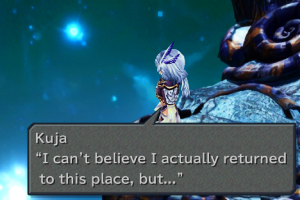
Kuja's self-relationship is complicated. By draining the color from his hair and hiding his tail, he hopes to distance himself from his accursed fate as a mere vessel and assert his individuality; it becomes clear on Terra, though, that his mode of dress is a stylization of what male Genomes wear. Furthermore, according to the Ultimania, Terra is the more magically advanced civilization to Gaia's inclination toward technology. Kuja leans heavily into sorcery insofar as to abstain from entering Oeilvert, an ancient structure that inhibits magic, by coercing Zidane to go in his stead. The Desert Palace, his abode on the Outer Continent beneath the quicksands, is also a Terran structure that manifested on Gaia after the failed assimilation by Garland five thousand years ago. In summation, Kuja fully identifies as Terran and never deigned to integrate himself into Gaian society beyond what ingratiations granted him power as a self-made noble. By choosing to dress in a manner akin to that of Terran culture, it suggests that a part of him still views Terra as home—or, at the very least, a more familiar place in spite of his estrangement from it.
Kuja: How sad . . . Any last words?
Garland: Your power is . . . meaningless.
Kuja: . . .
The story of Garland, Kuja, and Zidane is rather like that of a dysfunctional family wherein the eldest child is bitterly envious of the newborn. As much as he fears Garland, it seems Kuja, as the troubled son, desires some form of acknowledgment from his creator, who has only ever scorned him with clinical apathy. Being both prideful and emotionally underdeveloped, however, Kuja acts on anger and spite while Garland remains unflinchingly devout to his Terran makers. And so, in contrast to Zidane, who learns that he isn't alone so long as he has his friends in Pandemonium, Kuja is rejected by both others and himself.
Terra's stagnation and Gaia's dynamism
Once his plan to overthrow Garland teeters on the edge after his thwarted attack on Alexandria, Kuja drops his sinister theatricality and begins to show fits of juvenile temper, swinging between hysterics and snapping unprovoked at his subordinates. Until he grasps the source of Trance, an esoteric power once barred to him, he scrabbles for purchase by using everything and everyone within his reach to challenge his powerlessness under Garland's thumb. It's only after he successfully manipulates Zidane's party into opening a path to Terra by taking advantage of Hilda's rescue that he calms again, giddied by the prospect of finally wresting control from his creator.

Although a lover of theatre who realizes his schemes on Gaia like a playwright, his temperamental behavior upon losing control is Kuja at his most honest. Due to the nature of his creation, he never experienced a proper childhood during which he could grow and manage his emotions. Because Terra is a stagnant planet populated solely by Genomes and monsters, Kuja mostly knew only himself for the first eight years of his existence. This left him comfortable with solitude while inflating his self-importance as the only Genome in Bran Bal with a soul to call his own, giving rise to his pride in present day. Concurrently, the absence of meaningful interactions saw that he had no opportunities to reflect on his character outside of arguing with Garland about the meaning of his existence, which exacerbated matters.
Kuja serves as an excellent foil to Zidane, because he opposes his brother in every feasible way, right down to the complementary colors of purple and green in their designs. He's tall where Zidane is relatively shorter; the white (or silver) to his gold; the solitary to the companion; the selfish to the kind; the Terran to his Gaian. He even takes the souls of departed Gaians, many of whose deaths he caused, to achieve Trance in the same parasitic way Terra intends to subsume Gaia. The tragedy of Kuja's character comes from Zidane's understanding that, had they been in one another's shoes, they would've ended up like each other, as Zidane became the person he is now through his upbringing on the young and dynamic Gaia. By abandoning his loathsome rival on an alien planet, Kuja ironically gave Zidane the kind of life he desires the most, where the latter is free to abide by or leave the Tantalus Theater Troupe when it suits him while the former remains bound to Garland's authority.
Kuja's wish to rule over an eternal kingdom is, at the most fundamental level, a metaphor for autonomy. When he kicks Garland off the ledge to his death on Terra, he believes he's at last attained the power to truly live his own life as he pleases. Garland, however, reveals a truth that makes Kuja's freedom devastatingly short-lived.
Garland: Do you think a defect like you could last forever . . . ?
Kuja: . . . What? What do you mean!?
Garland: I built you to last only until the worthy Genome, Zidane, grew. It was too dangerous to let you last any longer than that.
Kuja: What are you saying . . . ?
Garland: There's a limit to your life . . . You'll be dead soon . . . Even as I die, you'll have died without ever leaving your mark on the world . . .
After twenty-four years of believing himself eternal and better than his Gaian counterparts, Kuja's self-esteem shatters upon realizing that he's no better than the black mages, who possess great power yet an inversely short life span. The fear that he'd lived with all his life and just released comes roaring back, and he throws what boils down to a temper tantrum by destroying Terra.
Trance is an untapped power granted to a select few on the planet, unlocked by a surge of emotion like anger. While Zidane and company are all able to utilize Trance naturally, Kuja's arrested development due to his Terran origins meant his emotions were too shallow. Garland had created Zidane as a newborn, because he'd assumed his first angel of death would never be able to reach that peak. Yet, for how Terran Kuja is all throughout FINAL FANTASY IX, he proves upon artificially manifesting Trance that he's actually more Gaian, and therefore dynamic, at his core.
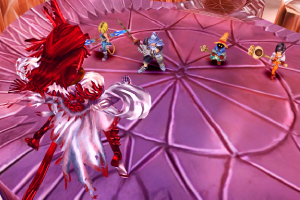
In Trance, Kuja deceptively appears to be more Terran than ever with a full body of red hair and the reveal of his once hidden tail. But there's something truly remarkable he accomplishes for one who was born into stagnancy: Kuja grows—literally. His height increases from approximately 214 cm (7') to 226.3 cm (7'5"). That's about five whole inches! Even his leitmotif, which went from "bad vibes only" to a more recognizable homage to "Slumber of Ancient Earth" in "Wicked Melody," swells to a turbulent crescendo in "The Darkness of Eternity."
In order to grow a new identity, the old self must first die. For Kuja, the birth of his nascent self begins with the death of his superficial narcissism. Only once he's been stripped of the thing he holds dearest—his very life—does he show his true face to the world. He admits to his lifelong fear upon his defeat in the Crystal World, where his misplaced anger seemed to have stemmed not just from a sense of unfairness, but also the newfound dread of dying alone if he must die, marking the beginnings of a paradigm shift.
Kuja: What comedy! Zidane, isn't it hilarious?! I'll die just like the black mages I so despise! I single-handedly brought chaos unto Gaia, but in the end, I'm nothing but a worthless doll!
Zidane and company fight Trance Kuja in the Crystal World, where he attempts to end all of creation, on March 8th. After his defeat, he casts Ultima as a desperation move before falling through the fabric of time and space, then down the Iifa Tree until he hits a patch near the bottom. The party, meanwhile, battle the embodiment of death summoned by Kuja's despair through the 9th. It's not until the 10th that they return to Gaia. In other words, Kuja spends an entire day in the basin of the Iifa Tree, dying a slow and lonely death with nothing but his own thoughts for company, during which he comes to several epiphanies—chiefly, that he'd gone about everything wrong. In coming to terms with his mortality and acknowledging his innumerable crimes, he reflects and truly grows for the first time.
Kuja: . . . I don't deserve to live after all that I've done. I'm useless to this world.
Zidane: No one's useless . . . You helped us escape, remember?
Kuja: . . . . . . After you guys beat me, I had nothing left . . . nothing more to lose. Then, I finally realized what it means to live . . . I guess I was too late.
The eyes are the window to the soul. While Kuja's hair is naturally red, his eyes are blue like the color of Gaia's moon. Poetically, he dies at peace atop Gaian soil on his own terms, having preempted Garland's time limit on his life span, after rectifying his fraternal sin of abandoning Zidane twelve years ago by teleporting him to safety from the Hill of Despair.
Knowing and recognizing only himself
Throughout Final Fantasy IX, Zidane shows up for as many people as he can with profound kindness in his heart. He possesses the emotional intelligence to recognize when others are in pain and if they should have company or be left to their devices. This compassion is what propels him to dive into the rampaging Iifa Tree in order to rescue Kuja at the end, knowing that their roles could easily have been reversed. In doing so, he makes it so that Kuja doesn't die alone.
For much of the story, Kuja is nothing like Zidane. He's selfish and cares only about himself, viewing Gaians and black mages as lesser beings to be used for his gains. He has a sadistic streak (and a torture chamber in his abode to indulge the need!) that relishes exerting his influence on those weaker than him—a compensatory mechanism meant to offload the crippling weight of his own imprisonment as Garland's slave.
Kuja: The weak lose their freedom to the strong. Such is the way of the strong. And it is the providence of nature that only the strong survive. That is why I needed strength.
Kuja is undeniably intelligent and well-read, storing many a book in the Desert Palace. Even so, it's a wonder how he, with his limited emotional quotient, was able to manipulate the once kind-hearted Brahne into slaying thousands and destroying entire countries out of greed. It could've been a learned tactic from the many plays he's watched and read. It could also be that he saw something in Brahne that he knew he could exploit, because he could recognize it—the fear of death.
A glimpse into Brahne's history in the Ultimania's timeline reveals that she'd lost many of her loved ones at a young age until there was nobody left, save for her surrogate daughter. As a ruler, she'd been warm and kind, yet undoubtedly griefstricken as a person. It's possible that Kuja transposed his desire for control onto Brahne, who'd lost so much and would have been enticed by such honeyed words. By seizing whatever lay within reach with the unstoppable might of the eidolons, she would have possessed everything, all while ironically forgetting why she desired such a thing in the first place by jeopardizing the life of her daughter.
Tangentially, Brahne and Garnet together serve as narrative parallels to Kuja and Zidane. Garnet illustrates her undying devotion to her beloved mother while Zidane demonstrates his compassion when he forgoes his dislike of Kuja to dive after him in the Iifa Tree. This parallel is also why both Brahne and Kuja find clarity in their dying moments, for death is the ultimate equalizer. When all possessions falls to the wayside before death's door, there are only the people who remain. By having Garnet and Zidane at their sides, Brahne and Kuja find their respective peace before passing.

Kuja not only bears narrative similarities to Brahne, but he also must have recognized some of her qualities. Like the black mages who put to mind his unwanted fate as a Genome, he could have related contemptuously to Brahne, and therein lies the possible third reason on the topic of why he treated her so poorly compared to Hilda. Whereas Brahne and the black mages reminded him of tasteless inferiority, Hilda's predicament as the spurned wife who'd been momentarily "replaced" by a mistress could have triggered a more bittersweet kind of familiarity. He might even have relished her vengeful spite if he knew that she'd bitten her thumb at her adulterous husband by turning him into an oglop.
It's because Kuja is so self-obsessed within the confines of FINAL FANTASY IX that he can be called empathetic. His ability to understand behavior outside of himself is poor, but he knows himself, and so he reacts more strongly—for better or for worse—to those who mirror him in his eyes.