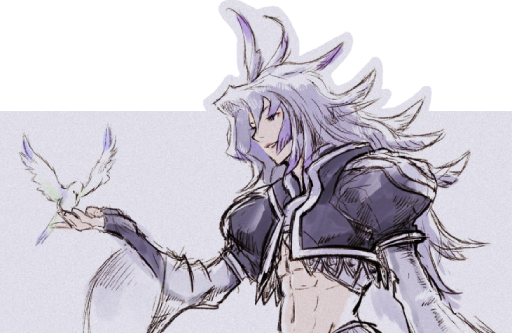
A capricious vanity
With the first DISSIDIA FINAL FANTASY came a revamped design for Kuja by Nomura Tetsuya. Sporting a middle part with wilder silver hair, purplish eyes, nail polish on pointed nails, and a rounded top, he also shrunk considerably in stature, presumably to avoid having him tower over everyone, including Sephiroth from FINAL FANTASY VII of all people, which had the unfortunate side effect of making Zidane even smaller. Kuja's overall features became sharper, and he received voice actors for the first time in Akira Ishida (JP) and JD Cullum (EN)!
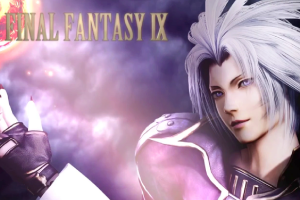
In DISSIDIA and DISSIDIA 012 FINAL FANTASY, where he's known as the Capricious Reaper, Kuja is a caster with versatile range and flexible combos. These games introduce his unique weapons dubbed cores. In DISSIDIA FINAL FANTASY NT, he's an assassin type who grows stronger over time with buffs that doubly support his allies. His preference for agility persists in DISSIDIA FINAL FANTASY OPERA OMNIA as a magic damage type. Initially slated to release in November, he was confirmed by the producer in a live stream to make his debut as a playable character in DISSIDIA DUELLUM FINAL FANTASY on September 29, 2026.
DISSIDIA as a crossover subseries traditionally develops Kuja's arc following his abrupt fate in FINAL FANTASY IX. In growing his character beyond the original source material's limited setting, he fulfills his narrative potential and more throughout multiple entries.
Waning will in war
While Kuja's story is a fairly standard homage to the original source material in the first incarnation of DISSIDIA, which tells the sprawling tale of a divine war, its revised script following 012's launch gives him a more tragic role as an unsung anti-hero with dubious motives. The implications surrounding his history in the feud between Cosmos and Chaos are rather insidious, but also reveal the person he is beneath his hateful veneer.
Kefka: The next time you fight, it'll be study time! All over again! Oh, what kind of deliciously depraved memories should I fill you up with this time around?
012 reveals that Kefka, another warrior of Chaos alongside Kuja, has been tampering with the latter's memories each time Kuja has fallen in battle, then observing him as one would a reprogrammed toy in the following cycles of war. Because of this, Kefka often appears in Kuja's scenes as a noisy interloper or a contemptuous eavesdropper. Interestingly, no amount of meddling from Kefka seems to stop Kuja from always circling back to the resolution that, no matter what, Zidane must live. By the time the story opens to the penultimate cycle, his narcissism is merely a comfortable front with which to conduct and shield himself.

Early in the twelfth cycle, Kuja has become so despondent over the neverending war as to harbor passively suicidal ideations. Oblivious to the fact that he's already fallen before, all he cares about for himself is safeguarding his memories from purification, even if it means taking them to the grave with him.
Kuja: Why fight when the outcome is so obvious? We warriors are simply singing the same tune over and over. Even without my voice, the hymn praising Chaos will not skip the smallest note.
Cloud: But, still . . . Isn't there one here you once called an enemy?
Kuja: Him? Oh, it no longer matters what happens to that one. All the encounters and memories in this world—none of it counts for a thing.
The existence of the Crystal World as an arena in DISSIDIA posits that Kuja and Zidane were summoned from the furthest point of FINAL FANTASY IX possible. If this is true, then the former's nihilism may be attributed to the unknown events of cycles past. As Chaos has won numerous cycles, many of Cosmos' heroes have had their memories expunged by Shinryu. In FINAL FANTASY IX, memory is the cornerstone of a life lived; someone who's passed can continue to live on through remembrance. Conversely, as was the case for Freya, who suffers from the distance created by her lover's amnesia, "to be forgotten is worse than death." To have been forgotten by the only person to ever understand and care for him, Kuja must have been crushed by Zidane's lack of familiarity in a previous cycle. But as his own memories and partiality remain, he goes on to assist Zidane in the only way he knows how—through deception, by posing as another warrior of Cosmos to take the fight straight to Chaos.
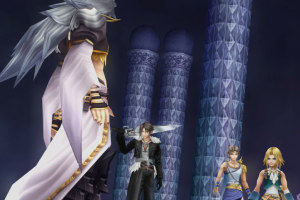
Defeating Chaos would spell the end of his warriors, including Kuja himself. Even if there's no longer any point to his own tired existence, he would ensure that Zidane and his companions survive. In this way, Kuja's actions during the twelfth cycle aren't simply motivated by a nihilistic desire for liberation, but also stem from understated affection. His hopelessness is eventually addressed by none other than Zidane himself in the thirteenth (and final) cycle, when he's particularly vicious toward him due to Kefka's tampering.
In 012, Kuja dissipates into black smoke upon a half-hearted loss to Lightning, signifying his allegiance with Chaos. This despairing end contrasts his hopeful finale in the thirteenth cycle, when he finds emotional purchase with Zidane after much torment at the hands of his fellow warriors of Chaos. There, he fades into light like a warrior of Cosmos after urging Zidane to move forward. Zidane's acceptance, both past and present, continues to be Kuja's driving force all the way to NT, where he openly defies the Emperor and Sephiroth in defense of Zidane and Terra.
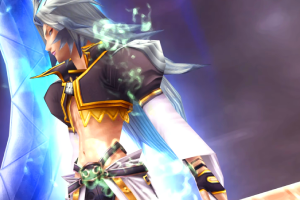
Instead of reacting to his powerlessness as a pawn with hatred as he had in the past, Kuja focuses outward on the one person who came for him in DISSIDIA. In doing so, he tries to be selfless until he's forced back into his unwanted role as a faithful warrior of Chaos by the Emperor, Kefka, and Ultimecia. Circumstances prevent him from assuming control, but his first act of independence upon reaching for his agency in NT is to help—just as Zidane would.
Empathy and compassion
From NT and onward, a softer side of Kuja blooms in less restrictive environments. This development soars to even greater heights in OPERA OMNIA, where he develops heartwarming friendships with Laguna and Raijin from FINAL FANTASY VIII. But Kuja's ability to recognize himself in others takes a positive turn as early on as in 012, when he comforts an uncertain Cloud and frees Terra from Kefka's mind control during the gods' neverending war.
Kuja: So, do you plan to follow that harlequin's orders till death? I wouldn't be able to stand being some idiot's pawn—without will or emotion.
Terra: . . .
Kuja: Hmph, I've changed my mind. Let's show your master my powers in another fashion. Whether you possess a will depends on you. Go forth to wherever your feet lead you. I shall break the bonds that tie you—his spell that confines you internally.
(It's a right shame that the localization never acknowledges the inherent awkwardness of Terra's name for Kuja, because she's called Tina in Japanese.)
In spite of his capacity to do good now that he's learned to focus outward, Kuja shuns the heroic persona by claiming aloof acquaintanceship and selfish caprice in the aforementioned cases. Even when both parties try to thank him, he denies any kindness on his part, choosing to distance himself instead. OPERA OMNIA elaborates on this evasive habit by pointing to his remorse for his time as Garland's angel of death. Because the weight of his sins sits heavily on his shoulders, Kuja is reclutant to admit to his better nature on top of his general awkwardness as someone who'd previously been so self-serving. This is where his likeness to Zidane makes itself more apparent: The Ultimania states that Zidane dislikes having his inner self perceived by others, preferring to avoid showing the depths of his heart if he can help it, hence his outburst at Pandemonium. Kuja's behavior throughout the DISSIDIA subseries suggests that he's the same way, albeit for different reasons; consequently, where he once deceived for the sport of it, he now lies to remain unseen by those around him.

Many of Kuja's actions in DISSIDIA are informed by Zidane's influence or the similarities in their natures, reinforcing the latter's belief that they easily could have switched roles in the story of FINAL FANTASY IX. Once the former is allowed the freedom to explore new experiences that life has to offer, his interactions with those like Laguna—and even a character in the collaboration with Another Eden!—demonstrate how much of Zidane's kindness he's internalized by going as far as to quote him when responding to another's pain with compassion.
Laguna: I guess this was all for nothing. The fruit report's probably useless too . . .
Kuja: I disagree. Nothing's useless. Everything has a purpose, even this little detour we took.
Not every good deed is committed with purpose. In the cases of Ovjang and Mneijing, Kuja asks himself why he'd help a couple of puppets reunite with their master after the fact. When he questions his own actions so, it implies that his intentions are sincere and not rehearsed with ulterior motives in mind (as much as he'd like to claim otherwise).
Room for growth
In act 2 of OPERA OMNIA, Kuja lashes out upon learning that he has actually been brought back to life and isn't the walking dead as he'd believed. His desire to prove that he's more than his fate backfires when he only manages to summon the Iifa Tree, a reminder of Garland's shackles, with his will in the World of Respite. The revelation that he's forever trapped in this loop breaks him, and he tries to cope by projecting his anguish onto Vivi. His mien takes on such a drastic turn that even the dark manikins, who don't understand emotions as vessels for lost memories, remark that something is wrong.
Trapped and upset, Kuja relapses. He seeks the validation of seeing someone else experience the pain of being forsaken by forcing Vivi through torturous scenarios and spells. This thinly veiled attempt at understanding in twisted solidarity fails, leading him to feel even more alone when Zidane's party defies his bleak expectations.
Aerith: Something's wrong with Kuja . . . His eyes are different than that time he helped us.
Kuja: I've had enough! I've always played the clown! Trying to escape the gods and my fate, but failing again and again! I tire of this play! I tire of this stage and this role and . . . everyone!
Kuja calms after Vivi reaches out to him in understanding of their mutual fear of death. While he rejects the claim that "there's still a place for [him], even after life ends" on the basis that he has nobody whereas Vivi has friends, he leaves to take responsibility for his mistakes with full awareness that doing so might kill him. The party come to the realization that what Kuja needs is a reason to live and urge him to make use of his limited time to the fullest. Their unexpected kindness, where Garnet makes the enormous gesture of embracing him as a "citizen of Gaia," thereby removing his othered status, moves Kuja insofar that his soul becomes devoid of the hatred Hilda once saw in a moment that directly parallels Zidane's "Not Alone" sequence.
Nobody has forgotten Kuja's crimes. He neither receives forgiveness nor asks for it, knowing that he deserves punishment. Kuja's story is one of understanding and forward movement. He, Zidane, and Vivi all recognize something meaningful in each other, and that's enough for the rest of the party to rise up in solidarity. There's no question that Kuja made the wrong choice in the past, but he now stands before them, trying to do what's right. His new lease on life is still limited, and he'll soon pass by whatever means Garland intended for him; even so, he can live beyond what fate demanded of him as a defective angel of death.
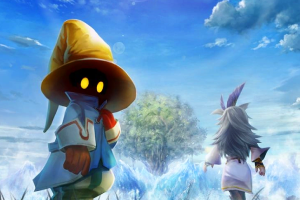
Of course, such a development doesn't happen overnight. Kuja retreats from the spotlight for a time, returning much later to assist the gods with Golbez when many of Spiritus' warriors are in disarray. At this point, he's still pondering his next course of action from day to day: Although his hatred toward his erstwhile enemies is no more, his self-reproach lingers, preventing him from enjoying life on his own. According to Bartz, he possesses a dour countenance. Reclusion doesn't serve him, and he finally arrives at a tentative solution in the company of Laguna and the disciplinary committee.
Laguna's persistent yet considerate nature in tandem with Raijin's sincerity prove to be a normalizing force for Kuja, who effects a sense of belonging by referring to Gaia as his "home world" as he chats openly about his noble hobbies. Rather than dwell on his past as an angel of death, they discuss the present and contemplate forward-thinking questions about their individual presence in the gods' world. From the eyes of Golbez, Kuja seems to be enjoying himself and healing through their kindness while also maturing through their worldly input whenever he says too much.
Kuja's doubts begin to surface when Laguna and Raijin tell him that they're glad to have met him. Because Laguna is so simple by nature and they lack a complicated history to muddle the waters, he finds it difficult to think him a liar. In fact, Kuja is the first to consider the idea of friendship; however, he's just as quick to dismiss that yearning for "self-satisfaction." He knows that connection is the answer to his existential conundrum, but can't in good conscience pursue it after all he's done.
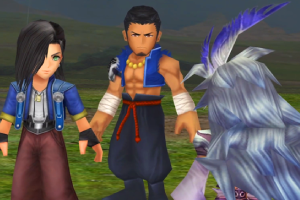
His self-loathing is soon challenged by Laguna, who casually refers to him as a friend before handing him a fruit. Uncomprehending of this gesture, he nevertheless takes the fruit with him and gives it a taste in thoughtful solitude. In the company of no one but himself, he's able to admit that he likes it after lying through his teeth nonstop to the others about having fun or being worried.
At the tender age of twenty-four, Kuja is a functionally intelligent and cultured adult. He's relinquished his hatred and mingles with familiar faces when the opportunity arises. At the same time, he still has much to learn. He can't take a compliment, because he's yet to learn how to love himself—but there are those who care about him and are willing to reach out to him. After a lifetime of rejection, that's as good a start as any.
Preservation in modernity
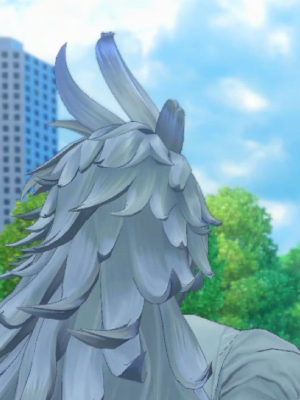
DUELLUM offers something new and exciting to the subseries with the inclusion of modern outfits for the cast. Players are granted a sneak peek at Kuja's attire in the seventh season, "Bridging the Distance," where he appears in a solo scene with his eyes cropped out of view for added mystique.
Kuja's fit for Tokyo encompasses an ombre blouse fastened with ribbons, charcoal jeans, and a pair of dress shoes. He retains his cosmetics and his nails, though still painted, are clipped short as in FINAL FANTASY IX. The trademark feathers on his head are also altered to resemble regular strands of hair. In observance of Eastern sensibilities, he covers his legs, but unbuttons his blouse at just the right level to bare a section of his toned midriff in true Terran fashion. Moreover, the design on his shoes resembles the buckles of his boots from his original look.
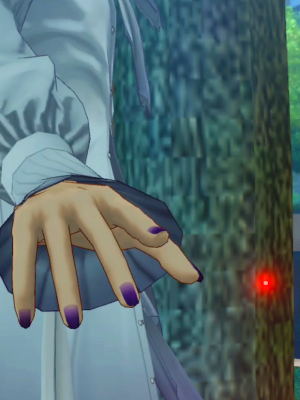
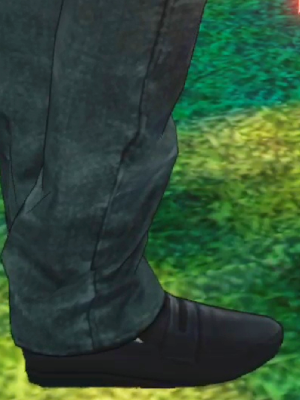
Perhaps the most fascinating element of Kuja's modern outfit is his belt! In lieu of traditional leather, he weaves a long ribbon through the loops of his jeans and ties it off at the front. Unlike Zidane, who wears the extra length of belt behind him, Kuja's sash is not visible from the back. Their belts may be references to their tails in that, while Zidane exposes his freely, Kuja hides his own by removing the semblance of one as it's the only strip of fabric that doesn't flow freely on his person.


Kuja makes his very first appearance as an anonymous contact (Otherworldly Reaper) in the fourth season, "A Planet in Peril." Here are my meandering thoughts on his FINE session with Sephiroth and Garland.