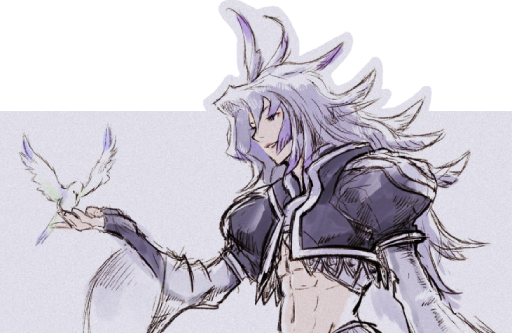
The queen's mysterious benefactor
Kuja initally debuts as Mystery Man at the end of disc 1 in FINAL FANTASY IX. Described as pale, white-haired, and strangely dressed by Zidane, he accompanies Queen Brahne on her invasion of Burmecia and is later revealed by Regent Cid to be her weapons dealer. He provided the recipe by which to produce the destructive black mages en masse, and in doing so enabled the queen to wage wars across the Mist Continent. Princess Garnet, convinced that Kuja was responsible for her mother's sudden turn to the dark side a year prior, seeks to eliminate him with or without Zidane's help.
Age: 24 years old
Height: ~214 cm (7')
Occupation: Sorcerer
A brutal, prideful man with a flair for the dramatic. — FINAL FANTASY Ultimania Archive Volume 2
Kuja's eye color is a subject of debate due to inconsistency throughout official materials. In most games, including the original, his eyes are colored blue; however, in some collaborations and artworks, they're purple. In fact, Itahana even gave him green eyes at one point! What's up with that?
While he appears as a man of mystery, Garnet goes on to retrospectively call him "the tall man" from her memory of the time he first met Brahne. Although difficult to tell due to the game's diminutive art style, Kuja is revealed in FINAL FANTASY Ultimania Archive Volume 2 to tower over most of the cast at a whopping seven feet in height. Between his impressive stature and Zidane's description of him, Kuja certainly leaves a strong impression wheresoever he goes, which was as intended by the art director, Hideo Minaba, who wanted "something with impact."
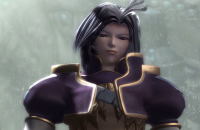
Having said all of that, Kuja is actually mentioned as early on in the story as Dali when Zidane regales "Dagger" with a recount of the Kings, a wealthy family of aristocrats in Treno. Zidane tries to tell her that the Kings "were hiding something in their mansion," referencing the time he framed Amarant, the security guard, and fled the scene after stealing from the auction house. The game only ever implies through the words of others that Kuja could be King, though a more direct confirmation would come years down the road in DISSIDIA FINAL FANTASY OPERA OMNIA, when Kuja mentions holding auctions in the past. Hilariously, he never learns that Zidane robbed him.
Auctioneer: How was Burmecia?
Kuja: Not bad . . . Better if I didn't have to see those vermin and the ugly elephant-lady. They offend my senses.
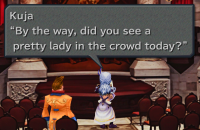
Between his early appearances in Burmecia and then Treno, Kuja wastes no time unveiling his narcissism. The FINAL FANTASY IX Ultimania affirms his confidence in his own looks—with Brahne herself saying that he has a "girly face"—and he proudly shows himself off by way of theatrical gestures and vernacular not unlike those of a strutting peacock. As a result of this self-importance, he's equally quick to dismiss those he finds somehow lacking and to treat them with disdainful prejudice while he regards the beautiful with more, albeit rehearsed and therefore disingenuous, tenderness.
His leitmotif, aptly named "Kuja's Theme," gives him a sinister air that's also been described as "bad vibes only" by a learned melophile. This video will become relevant again in the next section, but let's first finish going over others' impressions of Kuja by ending them with Lady Hildagarde, Cid's wife.
A narcissist who only knows hate
Hilagarde is a character who's mentioned early on in the story, yet who shows up much later when the party accidentally stumbles upon her in Mount Gulug while in pursuit of Kuja, who was keeping her prisoner. Despite having been in his captivity for about seven months from July to February 17th ever since he stole her airship, the Hilda Garde I, she reunites with Cid in a fairly unencumbered state.
Cid: Kuja didn't touch you, did he?
Hilda: His soul was filled with hate, but he was polite to me. He just talked an awful lot.
Cid: What about?
Hilda: Well, he divulged his master plan to me. I didn't even have to ask. It was tiresome. But what he spoke of . . . It was truly a scene from a nightmare.
What a thing to say about a known mass murderer who devastated the Alexandrian army and killed the queen before ravaging the kingdom of Alexandria itself!
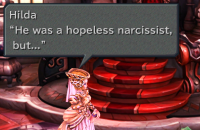
Hilda paints the picture of a hateful soul with grand designs on the planets of Gaia and Terra. Kuja is revealed to hail from the latter, establishing himself as an alien to the people of Gaia he's been terrorizing in person and behind the scenes through his manipulation of Brahne. With his narcissism well-known to everyone at this point, nobody doubts that Kuja blathered away his master plan to Hilda, simply because he could. After all, what villain of a play doesn't love a good monologue? Hilda even points out that he "became very impassioned as he spoke," which corroborates his surfacing temper following the events of his attack on Alexandria.
Kuja's alleged treatment of Hilda differs vastly from his contemptuous mockery of Brahne. The reasons for this are potentially threefold. Judging by how reverently he held the slumbering Garnet, who's regarded as the most beautiful woman in all of Alexandria, he must view Hilda in an aesthetically favorable light to have spared her life. Too, Kuja is largely shrouded in mystery even to those within Treno. The 1000-piece jigsaw puzzle themed after him is entitled "Reclusion" to reflect his separation from the people of Gaia as a whole, so it's also likely that he doesn't often have someone to whom he can talk. His inflated ego would have enjoyed the attention of a captive audience who couldn't walk away once she'd had enough . . . but a possible parallel between them and Brahne that Hilda didn't realize will be discussed on the next page.