The immaterial angel of death
Upon reaching Terra, Zidane learns from its overseer, Garland, that Kuja is an angel of death sent to wreak havoc on Gaia in order to prepare its assimilation by the dying, parasitic planet. He's revealed to be a Genome—a tailed human who serves as a vessel for the souls of slumbering Terrans. As an angel of death who was given the mission to expedite the assimilation of Gaia by Terra, Kuja enjoys the privilege of having a soul to act with intention where most of his kin remain empty vessels. His body doesn't age, and he was made as he looks now. His strong sense of self from the outset, however, resulted in rebellious ambitions that spurred Garland on to create a second angel of death eight years later.
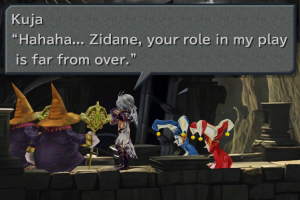
The creation of Zidane birthed two emotions in Kuja: envy and fear. Instead of eliminating the threat, he abandoned the four-year-old Zidane on Gaia out of spite to prove himself superior in time. For this act of insubordination, he was banned by Garland from entering Terra and thereby exiled to operate from within Gaia.
A beautifully ugly body
When the party first enters Bran Bal in Terra, they're greeted to the shocking sight of countless Genomes who all share Zidane's likeness between their heads of gold and tails. Even without taking the possession of a soul into account, it quickly becomes apparent that Kuja is something of an outlier among his own kind, effectively othering him on two planets. FINAL FANTASY Ultimania Archive Volume 2 further clarifies that he maintains appearances, though perhaps not in the way one might expect; rather than being blond like the rest of his kin, the original color of Kuja's hair is red like the moon of the very planet he's meant to serve.
For Kuja, who wishes to maintain his individuality more than anything else, any likeness to the subservient Genomes is one too many.
Zidane: Kuja!? He's a Genome!? Impossible! He doesn't even have a tail . . .
Garland: He is only hiding it. He denies his own identity. He rejects the meaning of his own existence and tries to assert his own individuality. Don't you see the resemblance?
Zidane: Shut up! I'm not like him at all!
Garland: He said the same thing when speaking about the other Genomes: 'I'm not like these guys.'
The Ultimania Archive states that Kuja's hatred and ridicule of the black mages, who are conceptually similar to Genomes, may stem from his self-loathing. As much as he raises his superiority over the purportedly inferior races of Gaia, Kuja truthfully suffers from body dysmorphia. He denies his tail, because it's a reminder of how much he utterly hates what he is. Beneath his narcissism is a bog of insecurities and anxiety as he struggles to love himself unconditionally and lives in fear of losing his soul to a single command from the all-powerful Garland.
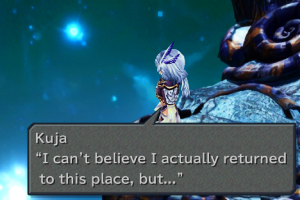
Kuja's self-relationship is complicated. By draining the color from his hair and hiding his tail, he hopes to distance himself from his accursed fate as a mere vessel and assert his individuality; it becomes clear on Terra, though, that his mode of dress is a stylization of what male Genomes wear. Furthermore, according to the Ultimania, Terra is the more magically advanced civilization to Gaia's inclination toward technology. Kuja leans heavily into sorcery insofar as to abstain from entering Oeilvert, an ancient structure that inhibits magic, by coercing Zidane to go in his stead. The Desert Palace, his abode on the Outer Continent beneath the quicksands, is also a Terran structure that manifested on Gaia after the failed assimilation by Garland five thousand years ago. In summation, Kuja fully identifies as Terran and never deigned to integrate himself into Gaian society beyond what ingratiations granted him power as a self-made noble. By choosing to dress in a manner akin to that of Terran culture, it suggests that a part of him still views Terra as home—or, at the very least, a familiar place in spite of his estrangement from it.
Kuja: How sad . . . Any last words?
Garland: Your power is . . . meaningless.
Kuja: . . .
The story of Garland, Kuja, and Zidane is rather like that of a dysfunctional family wherein the eldest child is bitterly envious of the newborn. As much as he fears Garland, it seems Kuja, as the troubled son, desires some form of acknowledgment from his creator, who has only ever scorned him with clinical apathy. Being both prideful and emotionally underdeveloped, however, Kuja acts on anger and spite while Garland remains unflinchingly devout to his Terran makers. And so, in contrast to Zidane, who learns that he isn't alone so long as he has his friends in Pandemonium, Kuja is rejected by both others and himself.