A narcissist who only knows hate
Hilagarde is a character who's mentioned early on in the story, yet who shows up much later when the party accidentally stumbles upon her in Mount Gulug while in pursuit of Kuja, who was keeping her prisoner. Despite having been in his captivity for about seven months from July to February 17th ever since he stole her airship, the Hilda Garde I, she reunites with Cid in a fairly unencumbered state.
Cid: Kuja didn't touch you, did he?
Hilda: His soul was filled with hate, but he was polite to me. He just talked an awful lot.
Cid: What about?
Hilda: Well, he divulged his master plan to me. I didn't even have to ask. It was tiresome. But what he spoke of . . . It was truly a scene from a nightmare.
What a thing to say about a known mass murderer who devastated the Alexandrian army and killed the queen before ravaging the kingdom of Alexandria itself!
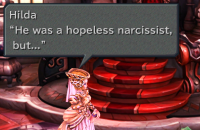
Hilda paints the picture of a hateful soul with grand designs on the planets of Gaia and Terra. Kuja is revealed to hail from the latter, establishing himself as an alien to the people of Gaia he's been terrorizing in person and behind the scenes through his manipulation of Brahne. With his narcissism well-known to everyone at this point, nobody doubts that Kuja blathered away his master plan to Hilda, simply because he could. After all, what villain of a play doesn't love a good monologue? Hilda even points out that he "became very impassioned as he spoke," which corroborates his surfacing temper following the events of his attack on Alexandria.
Kuja's alleged treatment of Hilda differs vastly from his contemptuous mockery of Brahne. The reasons for this are potentially threefold. Judging by how reverently he held the slumbering Garnet, who's regarded as the most beautiful woman in all of Alexandria, he must view Hilda in an aesthetically favorable light to have spared her life. Too, Kuja is largely shrouded in mystery even to those within Treno. The 1000-piece jigsaw puzzle themed after him is entitled "Reclusion" to reflect his separation from the people of Gaia as a whole, so it's also likely that he doesn't often have someone to whom he can talk. His inflated ego would have enjoyed the attention of a captive audience who couldn't walk away once she'd had enough . . . but a possible parallel between them and Brahne that Hilda didn't realize will be discussed on another page.