A capricious vanity
With the first DISSIDIA FINAL FANTASY came a revamped design for Kuja by Nomura Tetsuya. Sporting a middle part with wilder silver hair, purplish eyes, nail polish on pointed nails, and a rounded top, he also shrunk considerably in stature, presumably to avoid having him tower over everyone, including Sephiroth from FINAL FANTASY VII of all people, which had the unfortunate side effect of making Zidane even smaller. Kuja's overall features became sharper, and he received voice actors for the first time in Akira Ishida (JP) and JD Cullum (EN)!
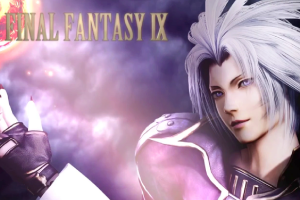
In DISSIDIA and DISSIDIA 012 FINAL FANTASY, where he's known as the Capricious Reaper, Kuja is a caster with versatile range and flexible combos. These games introduce his unique weapons dubbed cores. In DISSIDIA FINAL FANTASY NT, he's an assassin type who grows stronger over time with buffs that doubly support his allies. His preference for agility persists in DISSIDIA FINAL FANTASY OPERA OMNIA as a magic damage type. Initially slated to release in November, he was confirmed by the producer in a live stream to make his debut as a ranged Ghost in DISSIDIA DUELLUM FINAL FANTASY on September 29, 2026.
DISSIDIA as a crossover subseries traditionally develops Kuja's arc following his abrupt fate in FINAL FANTASY IX. In growing his character beyond the original source material's limited setting, he fulfills his narrative potential and more throughout multiple entries.
Waning will in war
While Kuja's story is a fairly standard homage to the original source material in the first incarnation of DISSIDIA, which tells the sprawling tale of a divine war, its revised script following 012's launch gives him a more tragic role as an unsung anti-hero with dubious motives. The implications surrounding his history in the feud between Cosmos and Chaos are rather insidious, but also reveal the person he is beneath his hateful veneer.
Kefka: The next time you fight, it'll be study time! All over again! Oh, what kind of deliciously depraved memories should I fill you up with this time around?
012 reveals that Kefka, another warrior of Chaos alongside Kuja, has been tampering with the latter's memories each time Kuja has fallen in battle, then observing him as one would a reprogrammed toy in the following cycles of war. Because of this, Kefka often appears in Kuja's scenes as a noisy interloper or a contemptuous eavesdropper. Interestingly, no amount of meddling from Kefka seems to stop Kuja from always circling back to the resolution that, no matter what, Zidane must live. By the time the story opens to the penultimate cycle, his narcissism is merely a comfortable front with which to conduct and shield himself.

Early in the twelfth cycle, Kuja has become so despondent over the neverending war as to harbor passively suicidal ideations. Oblivious to the fact that he's already fallen before, all he cares about for himself is safeguarding his memories from purification, even if it means taking them to the grave with him.
Kuja: Why fight when the outcome is so obvious? We warriors are simply singing the same tune over and over. Even without my voice, the hymn praising Chaos will not skip the smallest note.
Cloud: But, still . . . Isn't there one here you once called an enemy?
Kuja: Him? Oh, it no longer matters what happens to that one. All the encounters and memories in this world—none of it counts for a thing.
The existence of the Crystal World as an arena in DISSIDIA posits that Kuja and Zidane were summoned from the furthest point of FINAL FANTASY IX possible. If this is true, then the former's nihilism may be attributed to the unknown events of cycles past. As Chaos has won numerous cycles, many of Cosmos' heroes have had their memories expunged by Shinryu. In FINAL FANTASY IX, memory is the cornerstone of a life lived; someone who's passed can continue to live on through remembrance. Conversely, as was the case for Freya, who suffers from the distance created by her lover's amnesia, "to be forgotten is worse than death." To have been forgotten by the only person to ever understand and care for him, Kuja must have been crushed by Zidane's lack of familiarity in a previous cycle. But as his own memories and partiality remain, he goes on to assist Zidane in the only way he knows how—through deception, by posing as another warrior of Cosmos to take the fight straight to Chaos.
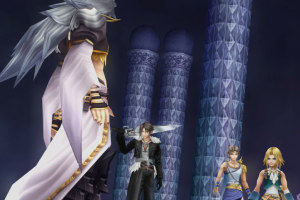
Defeating Chaos would spell the end of his warriors, including Kuja himself. Even if there's no longer any point to his own tired existence, he would ensure that Zidane and his companions survive. In this way, Kuja's actions during the twelfth cycle aren't simply motivated by a nihilistic desire for liberation, but also stem from understated affection. His hopelessness is eventually addressed by none other than Zidane himself in the thirteenth (and final) cycle, when he's particularly vicious toward him due to Kefka's tampering.
In 012, Kuja dissipates into black smoke upon a half-hearted loss to Lightning, signifying his allegiance with Chaos. This despairing end contrasts his hopeful finale in the thirteenth cycle, when he finds emotional purchase with Zidane after much torment at the hands of his fellow warriors of Chaos. There, he fades into light like a warrior of Cosmos after urging Zidane to move forward. Zidane's acceptance, both past and present, continues to be Kuja's driving force all the way to NT, where he openly defies the Emperor and Sephiroth in defense of Zidane and Terra.
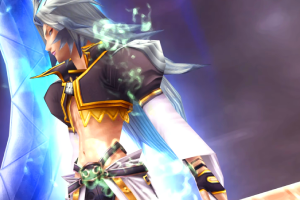
Instead of reacting to his powerlessness as a pawn with hatred as he had in the past, Kuja focuses outward on the one person who came for him in DISSIDIA. In doing so, he tries to be selfless until he's forced back into his unwanted role as a faithful warrior of Chaos by the Emperor, Kefka, and Ultimecia. Circumstances prevent him from assuming control, but his first act of independence upon reaching for his agency in NT is to help—just as Zidane would.